Vodou 401: The Will and the Rack
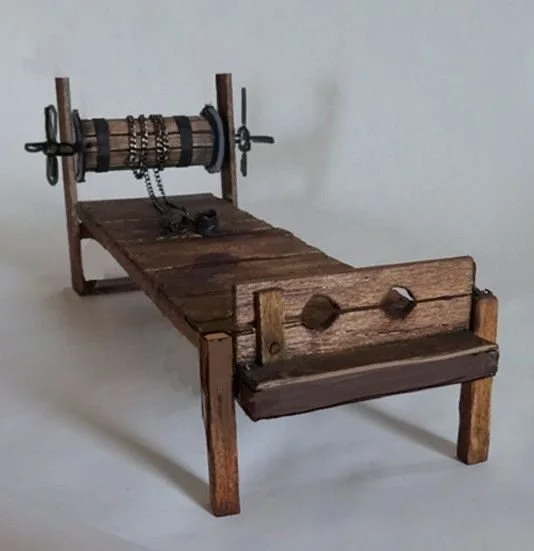
The metaphor of a rack for the experience of some lessons is fairly apt. The pressure increases and increases until something gives way, long past the point where you realize your body will betray you and long, long past the point of pain. You won’t get out of the lesson or off the rack until it is done, but you can always choose to struggle. You can cry, you can blame everyone else, you can scream and yell and try to make deals, but you cannot get off the rack nor can you get out of the lesson. A lesson is not uncommonly an ordeal, and ordeals have their own timing, their own logic.
The only real choice is you have is in how you face the ordeal.
This is a lesson, one that is often mixed inside other lessons—the lwa and divine like a two (or more) for one—sometimes, part of the lesson is in what you do when you can endure, not avoid. It is a lot easier to think of yourself as being accomplished when things go well, and when the challenge to you is minimal. If the challenge to you is consistently minimal, you are likely to think of yourself as being particularly good at whatever you’re facing, and perhaps a good person that deserves good things. You might even look down on people who are struggling more than you. Everybody gangster until the shit hits the fan, etc.
Ignorance is curable.
Ordeal exposes something that comfort or milder challenges do not: the degree of your will. It is in the pain, the uncertainty, the inescapable nature of ordeals that you find out what you’re made of, what you can be trusted with, and what you can be. Ordeal will show you if you are easily disturbed or distracted, unable to endure, quick to share the misery or lash out, if it is easy to make you betray others, and how motivated you are by pain.
Ordeal will also show you if you have enough will to make choices despite the physical pain, the distress, the awful weight of uncertainty. I will spoil a secret and say that, in the moment of, the choice does not have to be large. It can be the tiniest refusal you are capable of, a blind refusal to give in. That takes a lot more will than you’d think, especially if your experience of ordeals is mainly what you consume in media. You never have to finish triumphant, or effortlessly, or in a way that looks sufficiently victorious. You just have to finish however you can, which is its own lesson.
Understand, ordeals are not an every day occurrence. They last until they are resolved, but they are exceptional. They are also a gift, though you might not think it at the time. It is a gift to understand yourself more fully, and the gift of knowing that you are capable extends far outside the boundaries of the ordeal.
Priests will endure more ordeals than the average person. We spend a lot more time on the rack than most in part because it helps prepare us to serve our communities, in part because the priesthood is a position of advanced responsibility to ourselves and our lwa, not just our community.
The role of the head priest in a society encompasses a number of roles, from the person who puts others on the rack to the person who went first—the person who shows you how to make it through.